
Submitting an RFQ should be the beginning of a smooth manufacturing process, not the start of a long back-and-forth exchange to clarify missing details. When RFQs lack information, engineers and machinists spend valuable time chasing files and verifying requirements before a quote can even begin.
At Whitmer Industries, we designed our smart RFQ process to remove those bottlenecks. Because we’re focused on efficiency and quality, we use the Paperless Parts quoting platform to capture customer requirements clearly and move projects quickly into our quoting and engineering workflow.
We’ve already noticed measurable results, namely faster quotes and fewer surprises once production begins.
Why a Structured RFQ Process Produces Better Quotes
Quoting complex machining work requires more than simply reviewing a drawing. Engineers must analyze materials, tolerances, geometries, and machining strategies to determine how a part will be produced.
Our smart RFQ system automatically organizes and highlights these requirements, so our team can evaluate them efficiently. Instead of manually sorting through emails and attachments, the information flows directly into our quoting pipeline.
This structured approach helps our team quickly assess projects involving prototype machining, tight tolerance machining, and more. When the information is organized correctly from the beginning, the quoting process becomes faster and more accurate.
How Our Smart RFQ System Improves Speed and Accuracy
Whitmer Industries uses Paperless Parts to capture RFQ information and route it directly into our quoting workflow. Once a customer submits a request, the system automatically highlights key details such as tolerances, materials, and specific requirements. This allows our team to immediately begin evaluating manufacturability and cost drivers.
This speed can make a meaningful difference, especially for projects involving quick turn machining. Instead of spending time tracking down information, our team can focus on the work that actually adds value: analyzing the part and developing a reliable machining strategy.
Early DFM Feedback Helps Customers Avoid Costly Issues
One of the biggest benefits of our smart RFQ process is the ability to catch potential manufacturability challenges early.
During the quoting stage, our team reviews parts to identify areas where adjustments could improve production efficiency. This often includes:
Features with unnecessarily tight tolerances
Geometry that may be difficult to machine
Dimensions that could increase cycle time or inspection complexity
Opportunities to simplify manufacturing without affecting performance
When we identify something worth discussing, we reach out to the customer to understand the design intent. Often, small adjustments can significantly reduce cost and lead time.
These early conversations can dramatically improve the final outcome.
Secure Data Handling Protects Customer Information
Another advantage of the smart RFQ workflow is improved data security.
When RFQs are handled through email threads, files and requirements often bounce between multiple inboxes and systems. This increases the chance of version confusion or missing information.
With our smart RFQ platform, all project information stays within one controlled system. The data remains there until a customer places an order, at which point it moves directly into our ERP system.
Streamlined Communication Improves Collaboration
Our RFQ platform also includes integrated communication tools that allow customers and our engineering team to discuss projects within the system.
This simplifies collaboration by keeping all project discussions tied to the same RFQ record. Questions about tolerances, geometry, materials, or inspection requirements can be resolved quickly without creating fragmented email threads. This type of centralized communication helps ensure everyone stays aligned.
Best Practices for Submitting an RFQ
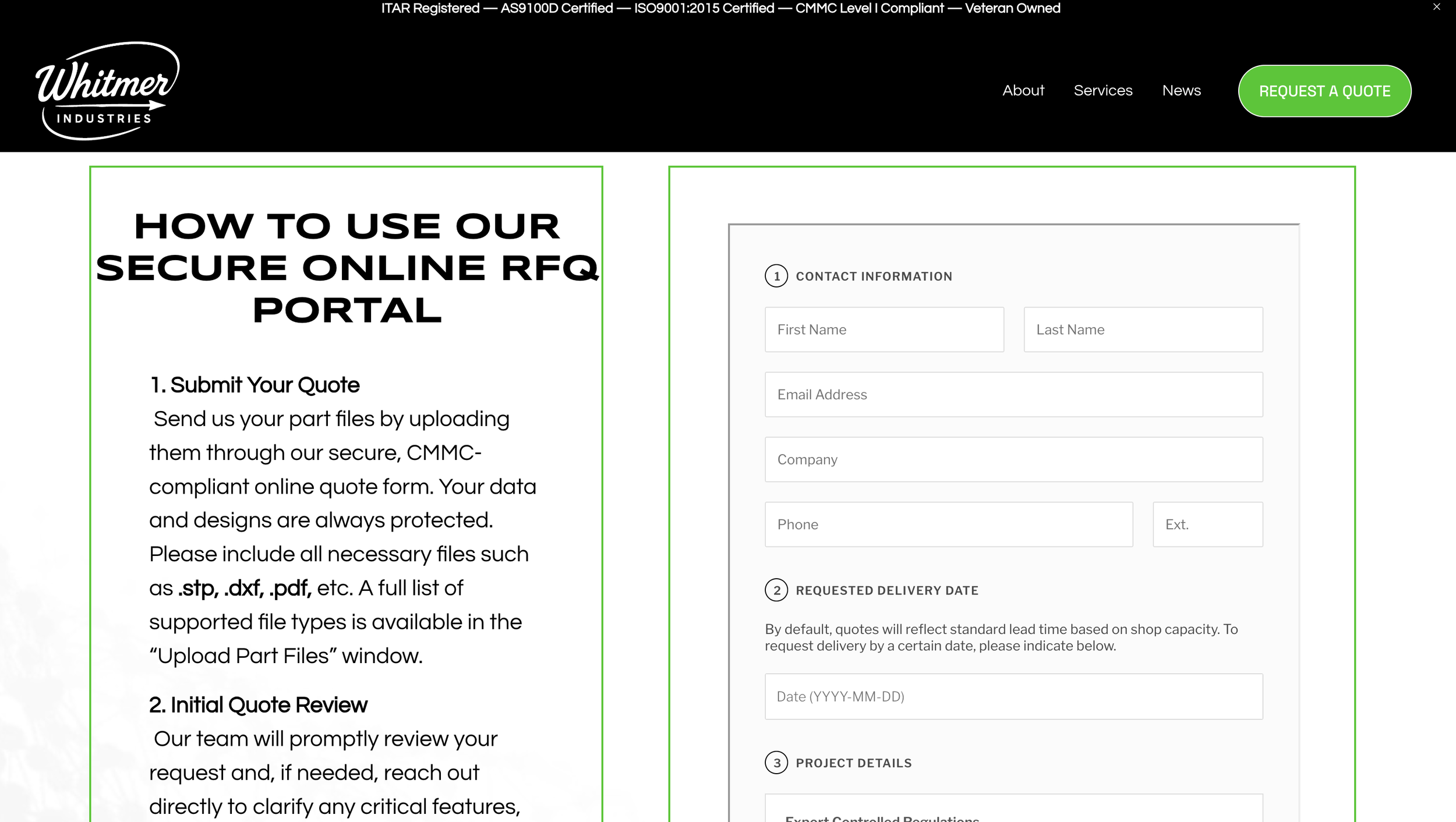
While our smart RFQ system helps organize information, providing complete design data will always speed up the quoting process.
Best practices include:
Include a CAD model whenever possible. A 3D model allows our engineers to fully evaluate part geometry and machining strategy.
Provide a drawing when available. Drawings should clearly call out critical tolerances, surface finishes, threaded features, and other important requirements.
Send a STEP file. STEP files preserve accurate scaling and geometry, which helps prevent interpretation issues.
Add notes for special requirements. If there are important manufacturing considerations, such as tight tolerance areas or critical features, be sure to include them in the RFQ notes.
By capturing complete requirements and highlighting manufacturability concerns earlier, Whitmer Industries can respond quickly while maintaining the precision our customers expect.
If you’re looking for fast, accurate feedback from a reliable machine shop, our smart RFQ process is designed to help you move from concept to production with confidence. Request a quote to get started!