
Whitmer Industries’ Inspection Menu: What Level of Inspection Do You Need?
At Whitmer Industries, we approach inspection with the same level of intentionality that we approach machining. Instead of applying a one-size-fits-all quality process, we offer structured inspection options.
Our three-tiered Inspection Menu allows customers to choose the level of inspection that best suits their parts. That way, they can align cost and precision needs with their actual requirements from the start.
Why Inspection Requirements Should Match Part Function
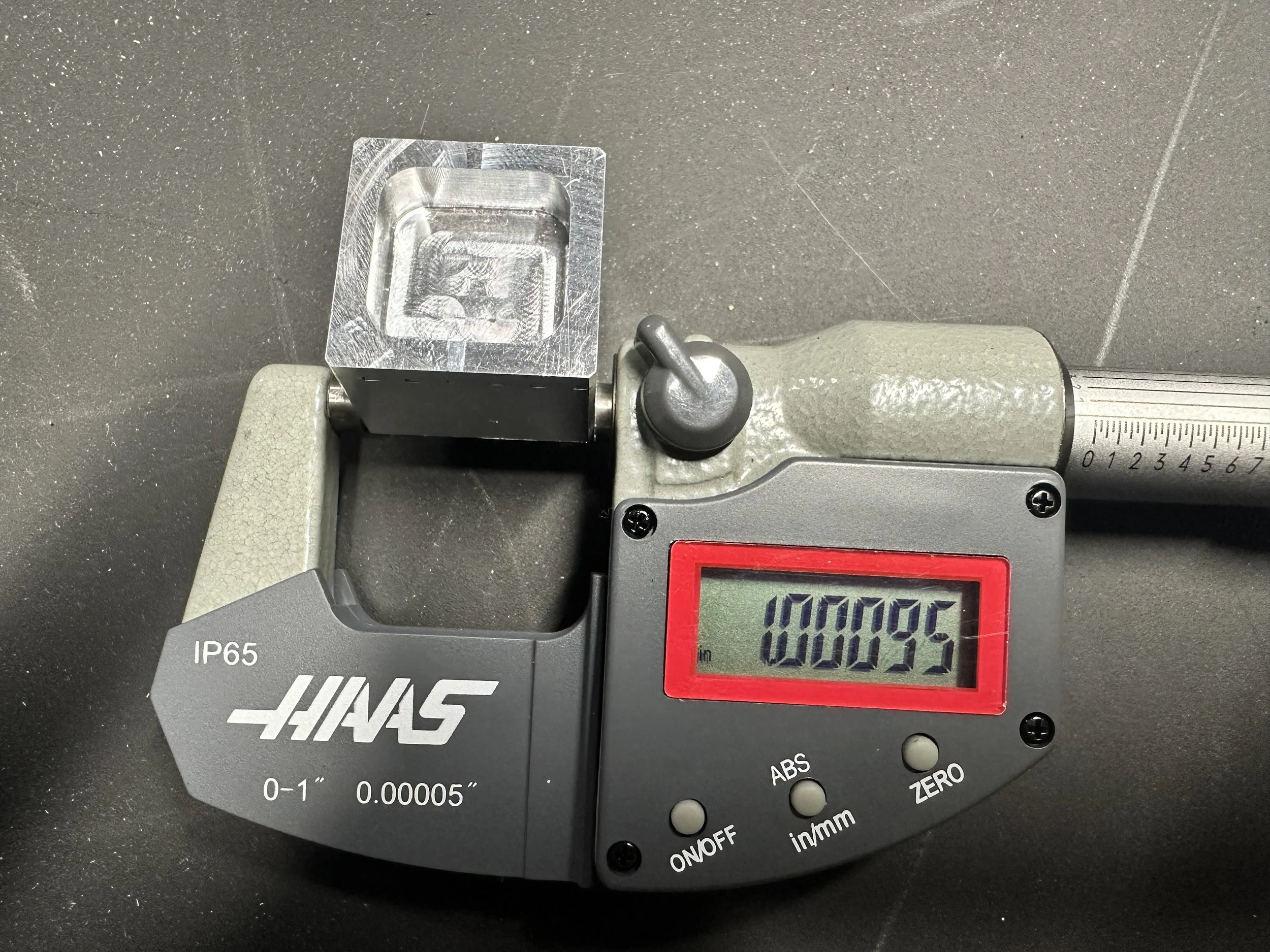
Not every feature carries the same level of importance. A simple mounting plate may only need general dimensional checks, while a robotic gripper or manifold may require full validation of complex geometries and tight tolerances.
We often see situations where a tolerance or inspection requirement is specified without fully considering how the part will be used. For example:
A hole might be called out with a tight tolerance, even though it only needs to allow a bolt to pass through
An angled feature may require CMM inspection, regardless of tolerance, because it cannot be reliably measured any other way
This is where experience matters. Our team helps customers align inspection requirements with real functional needs, so they’re only paying for what they need, not a bunch of extras!
Basic Inspection Package (Included)
The Basic level focuses on verifying key dimensions without over-processing the part.
Best for: Non-critical features and general-purpose parts
What it includes:
Manual inspection of critical features
Visual checks and overall dimensional validation
Program verification for standard features
Typical use case: A simple bracket or mounting arm where:
Exact positioning isn’t critical
Tolerances are relatively loose
Precision Inspection Package
This is a hybrid approach that combines manual inspection with targeted CMM validation.
Best for: Parts with critical features or tighter performance requirements
What it includes:
CMM inspection for critical features
Manual inspection for secondary features
Greater focus on feature relationships and fit
Typical use case:
Components with mating features
Lab or medical equipment parts that require consistent performance
Features that influence flow, alignment, or thermal behavior
Ultimate Inspection Package
This is the most comprehensive level of inspection, designed for parts where failure is not an option.
Best for: Highly complex parts with tight tolerances and multiple critical features
What it includes:
Full CMM inspection using automated programs
Validation of complex geometries and GD&T features
First Article Inspection (FAI) reporting
Traceable, repeatable inspection processes
Typical use case:
Robotic end effectors or grippers
Manifolds with multiple mating surfaces
Components with sub-thousandth tolerances
Parts used in large assemblies where tolerance stack-up matters
CMM Inspection Plays a Critical Role at Whitmer Industries
The Whitmer Industries team utilizes a Haas HMM430 CMM to support high-precision inspection. This allows us to:
Measure complex geometries that manual tools cannot adequately verify
Reduce the risk of human error
Create repeatable inspection programs for consistent results
Validate theoretical features and GD&T requirements
How to Choose the Right Inspection Level: Your Cheat Sheet
Here’s a simple way to think about it:
Choose Basic if:
The part has loose tolerances
Fit and function are straightforward
There are no critical mating features
Choose Premium if:
Certain features must align or perform precisely
The part interfaces with other components
Some level of validation is important
Choose Ultimate if:
Tolerances are extremely tight (sub-0.001”)
The part has complex geometry or GD&T callouts
Failure would impact a larger system or assembly
How Our Inspection Menu Benefits Our Customers
By offering structured inspection options, we give our customers:
Cost control: Pay for the level of inspection your part actually requires
Clarity: Understand exactly how your part will be inspected before production begins
Confidence: Know that critical features are verified using the right tools and processes
Just as importantly, our team is always available to guide you. If you’re unsure which inspection level is appropriate, we’ll review your part, understand your application, and recommend the best approach.
Ready to get started? Request a quote and specify your preferred inspection level!